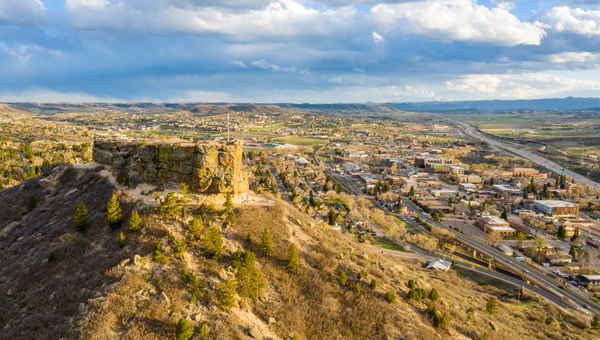
Everything you need to know about Castle Rock, Colorado
Castle Rock is one of those places that's easy to overlook on a map — it sits between Denver and Colorado Springs on I-25, and at first glance it can seem like just another suburban stop between two bigger cities. But spend some time here and a different picture emerges: a city with genuine historic character, a walkable downtown, over 130 miles of trails, one of the best school districts in Colorado, and a community identity that's distinctly its own.
Named for the striking rhyolite butte that rises above the valley — its flat top looking remarkably like a medieval fortress — Castle Rock has a history dating back to the 1870s, when it was established as a quarrying town and rail stop along the Denver & Rio Grande Railway. Today, it's the county seat of Douglas County and one of the fastest-growing communities in Colorado, with a population that has grown past 80,000 residents and shows no signs of slowing.
For buyers and families considering a move to the Colorado Front Range, Castle Rock offers something increasingly rare: a genuine sense of place, strong schools, abundant outdoor space, and a location that puts both Denver and Colorado Springs within easy reach. Here's everything you need to know about what life actually looks like here.
Castle Rock at a Glance
• Population: 80,000+ (one of Colorado's fastest-growing cities)
• Location: Douglas County, ~30 miles south of Denver, ~41 miles north of Colorado Springs
• Elevation: ~6,224 feet above sea level
• Median home price (2026): ~$635,000–$715,000 depending on property type and source
• School district: Douglas County School District (rated A- by Niche, third-largest in Colorado)
• Trails: 130+ miles of maintained trails; ~6,900 acres of open space
• Parks: 60+ parks including the landmark Philip S. Miller Park
• Major annual events: Castle Rock Starlighting, ArtFest, WineFest, Douglas County Fair & Rodeo
• Commute to Denver: ~30–45 minutes via I-25 (traffic-dependent)
• Commute to Colorado Springs: ~35–45 minutes via I-25
The Castle Rock Real Estate Market
Castle Rock's real estate market sits at the higher end of the Front Range price spectrum, reflecting its desirability, strong school district, and abundant open space. Median home prices in 2026 have generally ranged between $635,000 and $715,000 depending on the source and property type, with single-family homes typically commanding more and condos and townhomes offering more accessible entry points.
According to data from Orchard.com based on recent MLS activity, the median sale price in Castle Rock was approximately $715,000 in mid-2026, with homes selling in around 29 days on average — faster than the same period last year — and a sale-to-list ratio near 98%. Inventory has grown year over year, giving buyers more options than they've had recently, though the market remains tilted toward sellers in desirable neighborhoods.
Condos offer a significantly more accessible entry point, with median prices around $338,500 according to Houzeo's 2026 market data. Townhomes typically land in the mid-$400,000s to low $500,000s. For buyers who want space, newer single-family construction in Castle Rock tends to be generous — the average single-family home in the city is over 3,100 square feet, well above the national average.
One financial note worth knowing: the U.S. Census Bureau reports that the median household income in Castle Rock is approximately $136,000 — nearly double the national median. The community skews toward dual-income professional households, and that shapes both the price expectations and the amenities that continue to be built here.
Housing Styles in Castle Rock
Castle Rock's housing stock reflects its growth across several different eras. Historic neighborhoods like Craig-Gould near downtown feature Craftsman bungalows, four-squares, and cottages dating to the mid-1800s and early 1900s — many of which have been renovated and updated. The Plum Creek neighborhood, developed starting in 1985, offers postmodern and ranch-style homes along a golf course. Newer master-planned communities like The Meadows and Castle Highlands lean toward contemporary traditional and modern farmhouse styles, with larger square footage and newer amenities. High-end communities like Diamond Ridge and parts of Cobblestone Ranch offer custom builds on larger lots with sweeping Colorado scenery.
Market data sourced from Orchard.com Castle Rock Market Report (May 2026), Houzeo Castle Rock 2026 Housing Market data, REcolorado MLS via US Tech Automations (March 2026), and Homes.com Castle Rock City Guide.
Castle Rock Neighborhoods: Finding Your Fit
Castle Rock is made up of distinct neighborhoods that feel genuinely different from one another — which makes finding the right fit important. Here's a guide to the major areas:
Downtown Castle Rock
The heart of the city and its most walkable area. Historic rhyolite stone buildings line Wilcox Street, the main downtown corridor, with locally owned boutiques, cafes, restaurants, and tap houses filling many of the original structures. Castle Cafe, the longest-running restaurant in town, is a local institution. The area hosts frequent community events at Festival Park and Wilcox Square, and Rock Park — where the iconic Castle Rock butte rises above the valley — is steps away. Downtown apartments and condos make this the most urban option in the city.
Craig-Gould Historic District
A 16-block historic district just east of downtown, Craig-Gould is named for two of the town's founders and features some of Castle Rock's oldest homes: Craftsman bungalows, four-squares, and cottages dating to the mid-1800s and early 1900s. Many have been updated and renovated, creating a wide price range. The neighborhood is walkable to downtown restaurants and cafes and has a distinctive character you won't find in newer parts of the city.
Plum Creek
Situated about a mile south of downtown along the Plum Creek golf course, this neighborhood was developed starting in 1985 and offers a more suburban feel with postmodern and ranch-style homes ranging from 2,500 to 6,000 square feet. Homes are priced roughly in the $550,000 to $1.2 million range depending on size and location. A key feature: Plum Creek was developed outside the metro district boundaries, resulting in lower property taxes than many comparable neighborhoods — a meaningful difference for long-term homeowners.
Castle Highlands
Located just northeast of downtown, Castle Highlands is a newer, family-oriented community with ranch and two-story homes primarily built in the last 20 years. It offers excellent proximity to Philip S. Miller Park and easy access to downtown and I-25. Homes generally range from $650,000 to just under $1 million. Students attend Douglas County School District schools including Castle View High School, which offers four specialized academies in Biotechnology and Health Sciences, Leadership and Global Studies, STEM, and Visual and Performing Arts.
The Meadows
One of Castle Rock's largest master-planned communities, The Meadows sits on the western side of I-25 and offers a wide mix of home styles and price points — from entry-level townhomes in the upper $400,000s to larger single-family homes approaching $900,000. It has a strong sense of community with numerous parks, trails, and neighborhood events throughout the year.
Glover-Baldwin Park
A quieter, more established residential neighborhood on the foothills edge of Castle Rock, Glover-Baldwin Park offers a mix of condos, townhomes, and single-family homes at more accessible price points than some of the newer planned communities. One notable perk: no HOA, which is relatively uncommon in Castle Rock. Homes here back up to access trails leading to Castlewood Canyon State Park and Gateway Mesa Open Space.
South Town
Situated beneath the Castle Rock butte at the south end of the city, South Town features bi-level homes and ranches on larger lots with mature trees — a distinctly different feel from the newer suburban construction elsewhere in the city. Homes range from $400,000 to $750,000, and the neighborhood has a relaxed, community-oriented character. Residents are a short walk from Rock Park and Festival Park.
Cobblestone Ranch & Crystal Valley Ranch
Located in the southeastern part of Castle Rock near the I-25 corridor, these newer communities offer modern single-family construction with open spaces and trails. Crystal Valley Ranch in particular backs to open space in many areas and is popular with buyers looking for newer homes at relatively competitive price points within the Castle Rock market.
Outdoor Recreation: A City Built Around Open Space
Castle Rock dedicates roughly 30% of its total landscape to open space — approximately 6,900 acres — and maintains more than 60 parks and 130 miles of trails. For a city of its size, that's an exceptional commitment to outdoor living, and it shapes daily life here in ways that are hard to fully appreciate until you've experienced it.
Rock Park
The most iconic landmark in Castle Rock, Rock Park is where you'll find the rhyolite butte that gave the city its name. A trail leads up to the base of the formation and rewards hikers with panoramic views of the surrounding valley, Pikes Peak, and the broader Douglas County landscape. The 40-foot illuminated star on the butte's peak is lit each holiday season during the beloved Starlighting ceremony — a Castle Rock tradition since 1962.
Philip S. Miller Park
A 300-acre regional park that has become one of the most impressive community recreation facilities in the Denver metro area. The park features ziplines and ropes courses, an 8-mile trail network, a splash pad, an adventure playground with a 40-foot slide, and the Miller Activity Complex — a 64,000-square-foot indoor facility with turf fields, trampolines, and a swimming pool. The park's signature challenge is Challenge Hill: 200 steps rising 178 feet in elevation, a favorite for fitness enthusiasts and a genuine test of cardiovascular capacity at altitude.
Castlewood Canyon State Park
Spanning more than 2,600 acres on Castle Rock's eastern edge, Castlewood Canyon State Park is one of the most dramatic natural spaces on the entire Front Range. Rock climbing walls, more than 12 miles of trails, and canyon scenery carved by Cherry Creek make it a destination for hikers, climbers, and photographers from across the region. The ruins of the original Castlewood Canyon Dam, which failed catastrophically in 1933, are visible along several trail routes and add a layer of history to the landscape.
Plum Creek Trail & Bike Network
The East Plum Creek Trail winds for more than 8 miles through the city, connecting neighborhoods, the Douglas County Fairgrounds, downtown, and the Outlets at Castle Rock — all on a paved multiuse path away from traffic. Dedicated bike lanes run through Castle Rock's west and east sides and cross I-25 on the Hangmans Gulch and Plum Creek trails, making the city meaningfully more bikeable than most Colorado suburbs its size.
Golf
Castle Rock has multiple golf options, including the public Plum Creek Golf Club, which offers 18 holes with mountain views and a bar and restaurant, and Red Hawk Ridge Golf Course on the eastern side of the city. Both are popular with residents and accessible without membership.
Community Events & Local Culture
Castle Rock has a strong community events culture centered around its downtown and parks. Throughout the year, Festival Park and Wilcox Square host a rotating calendar of gatherings that give the city a genuine small-town feel despite its growth.
Castle Rock ArtFest, held each September, brings over 110 artists from across Colorado to downtown for a two-day outdoor art exhibition. WineFest follows a similar format with tastings from more than two dozen Colorado wineries, food demonstrations, live music, and the crowd-favorite Grape Stomp. Summer brings the Concert Series at Philip S. Miller Park's Millhouse outdoor amphitheater, a covered venue with seating and standing room that hosts local and regional performers throughout the season.
The Douglas County Fair & Rodeo at the Douglas County Fairgrounds is an annual summer tradition, with the horse parade down Wilcox Street — a Castle Rock institution since 1955 — opening the festivities. The Castle Rock Farmers Market runs Saturday mornings during the growing season, offering produce, baked goods, and local artisan products.
The highlight of the holiday calendar is the Castle Rock Starlighting, held the Saturday before Thanksgiving. The community gathers to watch the 40-foot, 100-bulb star on top of the Castle Rock butte illuminate for the season — a tradition that dates to the Great Depression, when the star was first installed as a symbol of hope. It remains one of the most genuine community moments in Douglas County.
Cost of Living in Castle Rock
Castle Rock sits at the higher end of the Front Range cost spectrum, primarily driven by housing. With median home prices in the $635,000–$715,000 range and a community that skews toward larger, newer construction, it's not an entry-level market. That said, the combination of Douglas County's favorable property tax environment, Colorado's flat 4.4% income tax rate, and the city's ongoing investment in infrastructure and amenities makes the value proposition compelling for buyers who can qualify at this price point.
Everyday costs — groceries, dining, utilities — are generally in line with other Douglas County communities and slightly above the national average. The Outlets at Castle Rock, one of the largest open-air outlet malls in Colorado, gives residents access to discounted name-brand retail without driving to Denver.
For buyers coming from coastal markets, Denver's northern suburbs, or Boulder, Castle Rock frequently represents a meaningful step up in space, lot size, and quality of life per dollar.
Things to Know Before You Move
• I-25 traffic is a real factor. If you'll be commuting to Denver daily, test the drive at actual commute times before committing to a neighborhood.
• The community skews toward families with children. Castle Rock has a strong family culture, which shows in the schools, parks, and event calendar — and shapes neighborhood demographics.
• Water security is a legitimate differentiator. Castle Rock Water has secured water capacity through 2060, which meaningfully distinguishes the city from other Colorado growth communities facing supply constraints.
• The altitude is real. At over 6,200 feet, Castle Rock sits higher than Denver. Give yourself time to acclimate if you're moving from lower elevations.
• HOA fees are common. Most master-planned communities in Castle Rock — The Meadows, Castle Highlands, Wolf Ranch — have HOAs. Factor those into your monthly budget.
• Property crime rates in Castle Rock have seen modest increases in recent years, though violent crime decreased roughly 19% between 2019 and 2023 according to the Castle Rock Police Department. The city runs proactive community programs including Rock Watch and Crime Stoppers.
• New construction is still happening. Castle Rock continues to expand, particularly on its eastern and southern edges. If you're buying in a newer development, research what's planned for surrounding parcels before committing.
Ready to Find Your Home in Castle Rock?
Castle Rock occupies a sweet spot that's increasingly hard to find on the Colorado Front Range: genuine community character, exceptional outdoor access, top-tier schools, and a location that puts you equidistant from two of Colorado's major cities. It's a place people come to for the convenience and stay for the quality of life.
Whether you're drawn by the trails, the downtown, the schools, or simply the feel of a community that knows who it is, Castle Rock rewards buyers who take the time to find the right neighborhood and the right fit.
If you're exploring a move to Castle Rock or anywhere across the Colorado Front Range, Shift Real Estate is here to help. We know these communities, the nuances between neighborhoods, and what it takes to navigate this market successfully.
Reach out today to start your Castle Rock home search.
Sources: Orchard.com Castle Rock Market Report (May 2026) | Houzeo Castle Rock Housing Market 2026 | REcolorado MLS data via US Tech Automations (March 2026) | Homes.com Castle Rock City Guide | Castle Rock Police Department crime statistics | Castle Rock Water | Colorado Department of Transportation (CDOT) | U.S. Census Bureau population and income data
Shift Real Estate Listings

© 2026 Shift Real Estate
DMCA Notice | Terms & Services | Privacy Policy | Accessibility Statement
EQUAL HOUSING OPPORTUNITY



Shift Real Estate
PO Box 2015, Castle Rock, CO 80104
Mobile: 303-587-0312
diane@shift.realestate